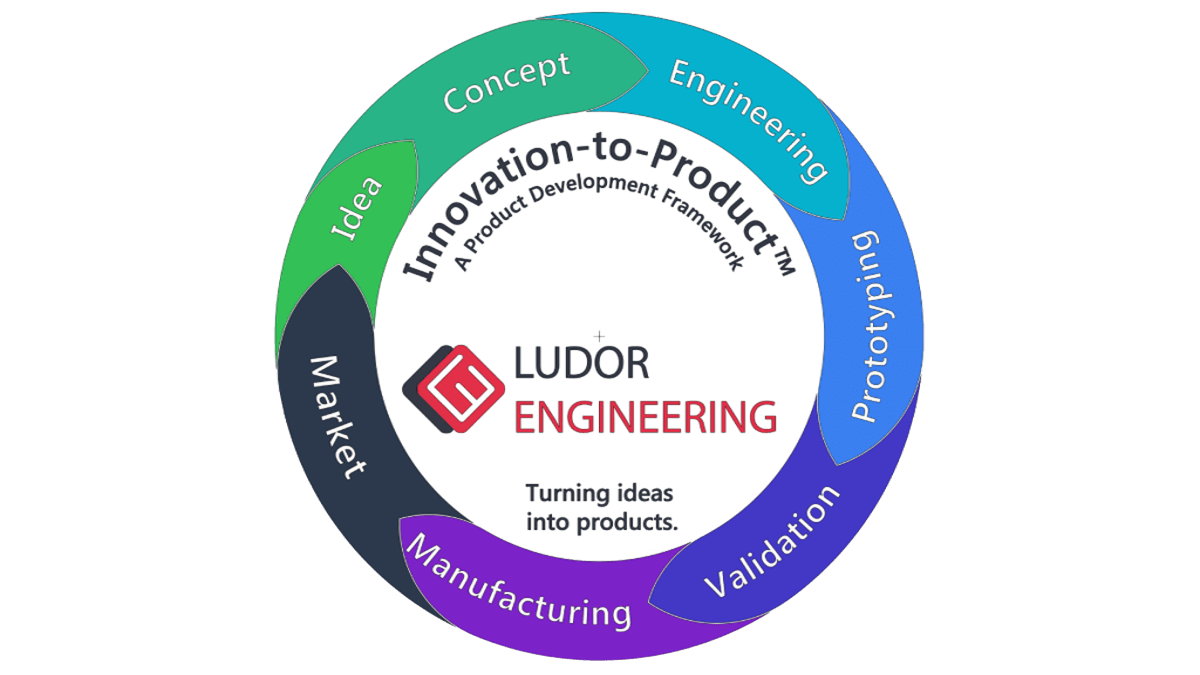
Innovation-to-Product™: From idea to product, through a clear development process.
A new product is not developed in a single step. Between an idea and a product ready for manufacturing, there is a series of technical decisions, prototypes, tests and iterations.
Innovation-to-Product™ is Ludor Engineering’s product development methodology, designed to structure this process and identify at an early stage any issues that may lead to costs, delays or redesigns.
The 7 stages of the Innovation-to-Product™ process: the complete product development cycle, from idea to market launch.
Every product development project starts from a different point.
Some clients come to us with an idea.
Others with a concept.
Others with a prototype.
And others with an existing product they want to improve.
Innovation-to-Product™ is flexible and starts exactly at the right stage for your project.
Why Innovation-to-Product™?
The difference between a risky idea based on costly trials and a structured engineering process that protects your budget and saves you time.
The traditional approach (without a methodology)
❌ Moving straight into production: Proceeding to tooling or production without a thorough DFM (Design for Manufacturing) validation.
❌Unforeseen costs: Modifications to tooling or parts that have already been manufactured can result in significant additional costs.
❌ Faulty prototypes: Parts that do not fit together during assembly, or materials that are unsuitable for the working environment.
❌ Significant delays: Work having to be redone and deadlines missed due to design errors that were not identified in time.
The Innovation-to-Product™ methodology
✅ 3D (CAD) validation: We identify and correct geometry and assembly errors directly on the digital model.
✅ Stay on budget: We eliminate the risk of costly changes by optimising the project before the first cut or injection.
✅ Rapid prototyping & testing: We produce physical prototypes and test them under real-world conditions before placing the production order.
✅ A transparent and predictable process: You know exactly what stage your project is at and what the next steps are – with no surprises.
The steps of the Innovation-to-Product™ process
The structured process through which we turn a vision into a viable commercial product, with minimal risks at every stage.
01
Idea
Feasibility & opportunity
We clarify the requirements and assess the technical and economic feasibility to validate the project’s viability.
02
Concept
Architecture & Solution
We explore design options and determine the optimal architecture: form, ergonomics and materials.
03
Engineering
3D CAD Design & Simulation
We create 3D models of all components, check the fits and assembly interfaces, and carry out the necessary simulations.
04
Prototyping
Fast physical validation
We create physical prototypes using 3D printing and CNC, turning digital designs into tangible objects.
05
Validation
DFM/DFA Testing & Optimisation
We are testing the prototype and optimising the geometry to ensure easy manufacturing and assembly.
06
Manufacturing
Manufacturing & documentation
We produce the drawings, 3D files, and provide technical support in relation to suppliers and manufacturers.
07
Market
Industrialisation & Assistance
We provide support with the launch of mass production and the final adjustments required to successfully scale the product for the market.
Are you ready to turn your idea into a real product?
Book an initial technical consultation. We’ll assess your project and work with you to map out the first steps, with no risk involved.
To provide the best experiences, we use technologies like cookies to store and/or access device information. Consenting to these technologies will allow us to process data such as browsing behavior or unique IDs on this site. Not consenting or withdrawing consent, may adversely affect certain features and functions.
Functional
Always active
The technical storage or access is strictly necessary for the legitimate purpose of enabling the use of a specific service explicitly requested by the subscriber or user, or for the sole purpose of carrying out the transmission of a communication over an electronic communications network.
Preferences
The technical storage or access is necessary for the legitimate purpose of storing preferences that are not requested by the subscriber or user.
Statistics
The technical storage or access that is used exclusively for statistical purposes.The technical storage or access that is used exclusively for anonymous statistical purposes. Without a subpoena, voluntary compliance on the part of your Internet Service Provider, or additional records from a third party, information stored or retrieved for this purpose alone cannot usually be used to identify you.
Marketing
The technical storage or access is required to create user profiles to send advertising, or to track the user on a website or across several websites for similar marketing purposes.